5 Critical Metrics for Operational Intelligence Systems
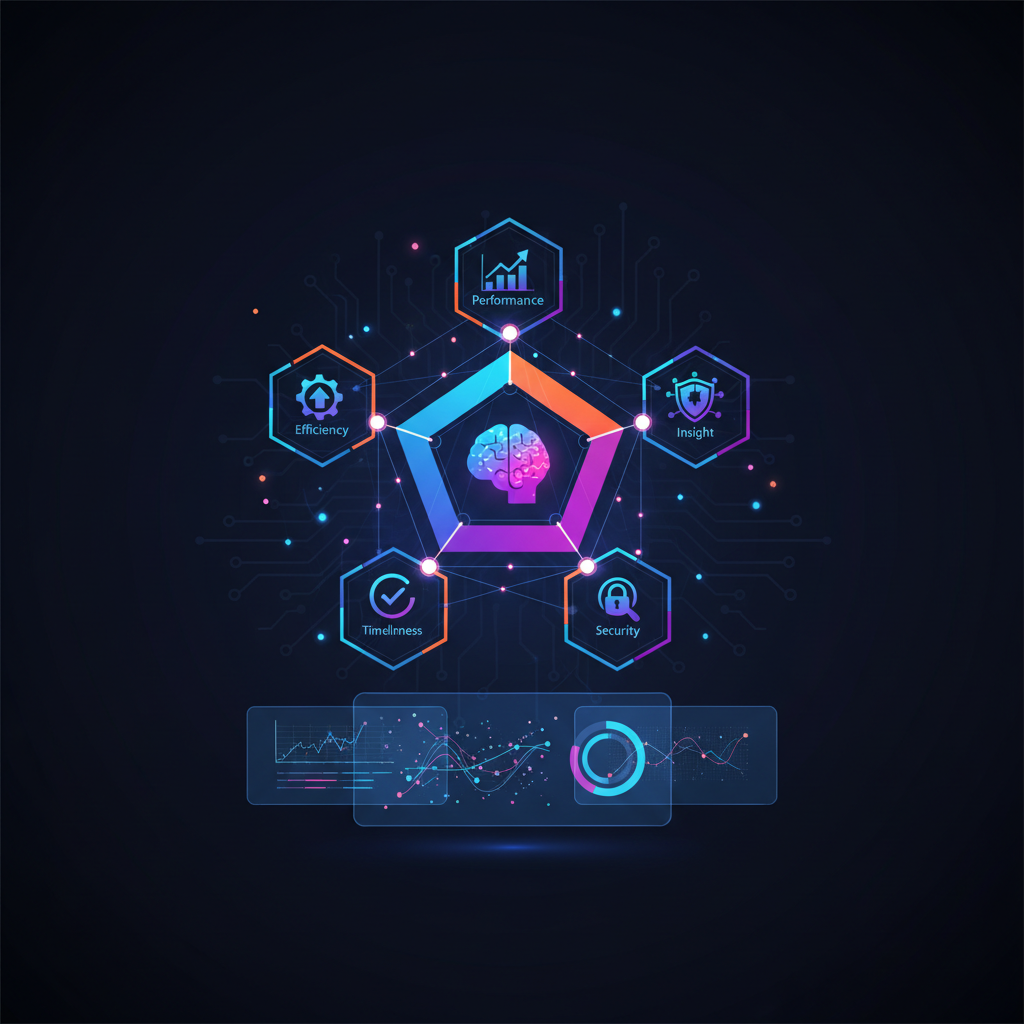
Discover the 5 essential metrics that measure operational AI success. Learn how H.E.R.M.E.S. transforms enterprise decision-making with data-driven insights.
Introduction
Your enterprise runs on decisions. Every day, your operations team makes hundreds of calls: resource allocation, process optimization, risk mitigation, bottleneck resolution. But how many of those decisions are based on real-time data versus gut feeling and legacy systems?
For CTOs, CEOs, and operations directors across Mexico and Latin America, this is the core problem: operational intelligence without the data intelligence behind it is just management theater. You can automate workflows, but if you're not measuring the right things, you're optimizing blindly.
The difference between enterprises that thrive and those that stagnate isn't the technology they deploy—it's the metrics they track. Rhodium's H.E.R.M.E.S. (Human Enhanced Metrics Engine Systems) solves this by assembling operational intelligence that doesn't just report what happened; it predicts what will happen and recommends what should happen next.
In this guide, we'll walk through the 5 critical metrics that separate operational mediocrity from operational excellence.
1. Process Cycle Time Reduction – The Foundation of Operational Velocity
What it measures: The time required to complete a full operational process from start to finish.
Why it matters: Cycle time directly impacts customer satisfaction, cash flow, and employee burnout. A manufacturing plant that cycles parts in 8 hours instead of 12 doesn't just produce more—it frees up capital, reduces storage costs, and cuts labor waste.
Real numbers: In our deployments across government and enterprise clients in Mexico, we've seen cycle time reductions of 25-40% in the first 90 days. Why? Because operational intelligence systems identify the exact step where time is lost—not through guessing, but through real-time data from every checkpoint.
How H.E.R.M.E.S. measures it:
- Tracks process entry and exit timestamps across all departments
- Identifies bottlenecks automatically through pattern recognition
- Alerts decision-makers when a process exceeds baseline by 15%
- Correlates delay causes with resource availability and external factors
Without these metrics, you're asking: "How long does this take?" With them, you're asking: "Why is this taking longer today, and what do I fix right now?"
2. Resource Utilization Rate – Turning Idle Assets Into Revenue
What it measures: The percentage of time your assets (people, equipment, infrastructure) are actively engaged in value-generating work.
Why it matters: A production line running at 62% capacity isn't producing at 62%—it's hemorrhaging profit. Every idle hour is lost revenue that competitors are capturing. In enterprises, this metric separates the profitable from the barely-viable.
Real numbers: Most companies discover their true utilization rates only after deploying operational intelligence. Average findings: 30-45% of operational capacity goes unused due to poor visibility, scheduling conflicts, or wait times between processes.
For a manufacturing operation with $2M in monthly equipment costs, a 15% improvement in utilization is $300K in incremental revenue—from better metrics, not new hardware.
How H.E.R.M.E.S. measures it:
- Real-time asset tracking (machines, personnel, vehicles, infrastructure)
- Correlates availability with demand to reveal scheduling inefficiencies
- Identifies "zombie processes"—activities that consume resources but don't generate value
- Forecasts optimal resource allocation based on demand patterns
3. Decision Latency – The Speed of Operational Response
What it measures: The time between when a problem is detected and when a decision is made to address it.
Why it matters: In hospitality, retail, energy, or healthcare, latency kills service quality and profit margins. A restaurant that discovers a supply shortage 6 hours into service is a disaster. A clinic that realizes a doctor is overbooked after patients arrive is a credibility disaster. An energy operation that responds to grid stress 30 minutes late is a financial and infrastructure disaster.
Real numbers: Enterprises using traditional reporting systems have decision latency of 4-24 hours. Operational intelligence systems reduce this to minutes or seconds.
The business impact: A hotel using HeroHotels (our hospitality H.E.R.O. agent) reduces guest complaint response time from 2 hours to 12 minutes. That's not faster—that's a different business.
How H.E.R.M.E.S. measures it:
- Tracks alert-to-decision time across all critical operations
- Identifies decision bottlenecks (missing stakeholders, unclear protocols, information gaps)
- Automates routine decisions, escalating only strategic choices to humans
- Measures decision quality against actual outcomes
4. Cost Per Transaction or Cost Per Unit – The Profit Multiplier
What it measures: The total operational cost required to deliver one unit of value (a transaction, a product, a service delivery).
Why it matters: This is where automation with AI actually shows its teeth. A restaurant that reduces cost-per-plate from $8 to $5.20 through HeroBistro's super agent orchestration doesn't just run cheaper—it can undercut competitors or pocket 35% more margin.
Real numbers: Our clients see 20-35% reduction in cost-per-unit within 180 days. This comes from:
- Labor optimization (no idle time, no rework)
- Waste reduction (spoilage, defects, overproduction)
- Energy efficiency (right resource deployment)
- Procurement intelligence (better purchasing patterns)
For an enterprise moving $50M in annual transactions, a 8% cost reduction is $4M to the bottom line.
How H.E.R.M.E.S. measures it:
- Breaks down full cost allocation per unit (labor, materials, overhead, technology)
- Identifies cost drivers and variance explanations
- Forecasts impact of operational changes before implementation
- Benchmarks performance against peer operations and industry standards
5. Operational Resilience Score – The Risk Multiplier
What it measures: Your operation's ability to absorb disruptions (supply chain breaks, equipment failure, demand spikes, personnel absence) without critical service loss.
Why it matters: Traditional operations are fragile. One broken link and the whole chain stops. Operational intelligence creates redundancy awareness and automatic failover.
A healthcare facility with low resilience scores can't handle a doctor absence or equipment failure. A government operations center can't handle demand spikes or system failures. An energy operator can't handle grid volatility.
Real numbers: Enterprises score themselves on a 0-100 resilience index. Most score 45-65 before deploying H.E.R.M.E.S.—meaning they're one disruption away from cascade failure. After implementation, scores rise to 80-92 within 120 days.
The business impact: Zero unplanned downtime costs vastly more than the infrastructure investment to prevent it.
How H.E.R.M.E.S. measures it:
- Maps all critical dependencies (who depends on what)
- Stress-tests operations against failure scenarios (no visibility model)
- Identifies single points of failure
- Recommends redundancy and auto-failover protocols
- Monitors resilience in real-time
How Rhodium Solves This: H.E.R.M.E.S. in Action
Rhodium doesn't sell you a "business intelligence platform" or a "dashboard tool." That's not how we operate.
H.E.R.M.E.S. (Human Enhanced Metrics Engine Systems) is an assembled, purpose-built operational intelligence system that:
- Designs the metrics architecture for your specific operation (manufacturing, government, energy, healthcare, logistics)
- Assembles the best-in-class data collection, processing, and AI components
- Operates the system so you get insights, not raw data; decisions, not reports
Using our Get Shit Done™ methodology, we deploy H.E.R.M.E.S. in 30 days. By day 15, you have real-time metrics. By day 30, you have automated recommendations flowing to your operations team.
Real case: A government operations center in Mexico deployed H.E.R.M.E.S. and within 60 days:
- Reduced process cycle time by 31%
- Improved resource utilization from 58% to 79%
- Cut decision latency from 8 hours to 22 minutes
- Identified $1.2M in annual cost reduction opportunities
- Increased operational resilience score from 52 to 87
No custom software built. No six-month implementation. No "pilots" that become permanent limbo states.
The Metric That Matters Most: Time-to-Impact
Here's what separates Rhodium from everyone else offering "operational intelligence": we measure success by how fast you see real numbers, not how beautiful the dashboard is.
Your CTO cares about system architecture. Your CEO cares about profit. Your operations director cares about not getting 2 AM calls about failures.
H.E.R.M.E.S. delivers metrics that matter to all three—and we prove it in 30 days.
Ready to Operate with Real Metrics?
Grupo Rhodium designs, assembles, and operates AI systems that transform enterprise operations. We don't sell software packages—we build metrics-driven decision systems with Get Shit Done™ methodology.
If your operation runs on gut feelings instead of data, or on reports that arrive too late to matter, let's talk.
Contact us on WhatsApp and tell us your operational challenge.
For more insights on operational AI, check out more articles on our blog.
Visit Grupo Rhodium to learn how we design, assemble, and operate operational intelligence systems for Mexico and Latin America.