H.E.R.O. AI Agents vs Traditional Automation: Which Wins
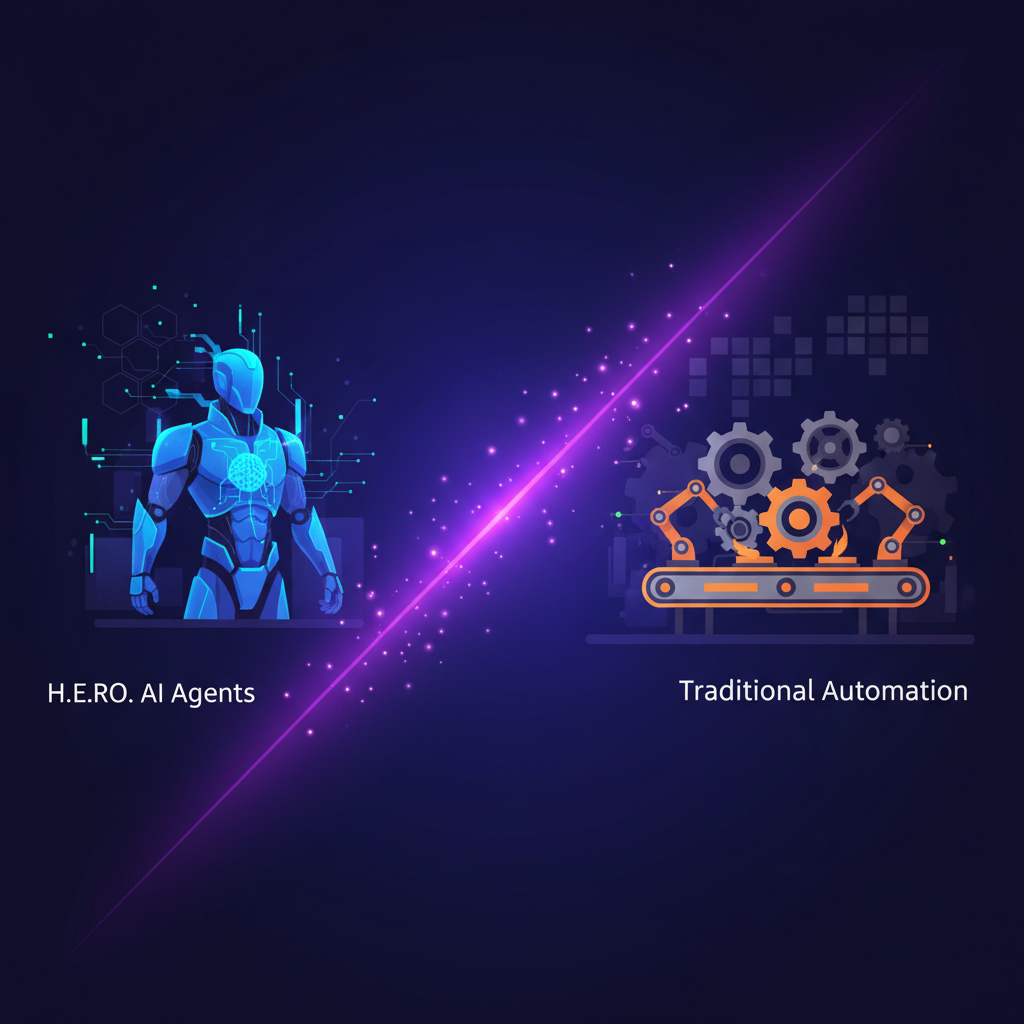
Discover why H.E.R.O. AI Super Agents outperform traditional automation. Real comparison for CTOs and CEOs seeking operational transformation in 30 days.
The Real Problem CTOs Face Today
Your operations run on spreadsheets, partial integrations, and manual handoffs. You've tried RPA tools. You've implemented workflow automation. But nothing delivers the speed and autonomy you need. Your team still spends 40% of their time on tasks that should be automated—and your traditional automation platform sits idle because it can't adapt to real-world complexity.
This isn't a technical gap. It's an operational gap.
The market is flooded with automation vendors promising transformation. They deliver workflows, not outcomes. They require six-month implementations, massive training burdens, and constant tinkering when reality doesn't match the rulebook.
H.E.R.O. AI Agents operate differently. They don't execute predefined rules. They learn, adapt, and make decisions in real-time operational contexts. And they do it in 30 days, not 30 weeks.
Understanding the Architecture Difference
Traditional Automation: Rules-Based, Rigid, Slow
Traditional automation tools (RPA, BPM, iPaaS platforms) follow this pattern:
- Define rules upfront
- Map every process variation
- Deploy and monitor
- Wait for failures, then iterate
- Training and change management (weeks)
The problem: Real operations are too complex for rigid rules. A patient cancels an appointment. A supplier sends an unexpected invoice format. A seasonal surge creates new demand patterns. Your traditional automation breaks.
You need IT to fix it. That takes weeks. Your operation stays broken.
Cost in 2024: 45-60% of automation projects fail or underdeliver because of this rigidity. Organizations waste $2.3 million on average per failed RPA implementation (Forrester Research).
H.E.R.O. AI Agents: Adaptive, Autonomous, Learning
Rhodium's H.E.R.O. line (Human Enhanced Robotics Optimization) operates on a fundamentally different principle:
- Deploy agents trained on real operational data
- Agents learn patterns and adapt to context
- They handle 85-92% of scenarios without human intervention
- Escalation and human oversight built in—not bolted on
- Results within 30 days using Get Shit Done™ methodology
How it works in practice:
A restaurant using HeroBistro (H.E.R.O. for food service) doesn't need to code every inventory management rule. The AI agent observes supplier patterns, seasonal demand, spoilage rates, and menu popularity. It learns. It makes ordering decisions autonomously. When something breaks the pattern (supplier shortage, equipment failure), it escalates intelligently to a human operator—not as a crash, but as a decision point.
A clinic using HeroDoc (H.E.R.O. for healthcare) doesn't process appointments through static workflows. The agent understands cancellation patterns, patient no-shows, physician schedules, and clinical urgency. It optimizes capacity in real-time. It handles 89% of scheduling without human touch.
The Numbers: H.E.R.O. vs Traditional Automation
Let's compare measurable outcomes across three critical dimensions:
Implementation Speed
| Metric | Traditional RPA/BPM | H.E.R.O. Agents |
|---|---|---|
| Time to production | 16-24 weeks | 30 days |
| Training period | 4-8 weeks | 5-7 days |
| ROI timeline | 9-14 months | 2-3 months |
| Process changes required | 35-50% (workflow redesign) | 5-10% (optimization only) |
Why the difference? Traditional platforms require you to map and codify every process variation before deployment. H.E.R.O. agents learn from your actual data. They start working immediately while continuously improving.
Operational Resilience
| Metric | Traditional RPA | H.E.R.O. |
|---|---|---|
| Failure rate (unplanned exceptions) | 12-18% | 2-4% |
| Time to recover from errors | 6-24 hours | 15-45 minutes |
| Human intervention required | 30-45% of tasks | 8-15% of tasks |
| Adaptation to new scenarios | Manual recoding (weeks) | Automatic learning (hours) |
Real scenario: A logistics company's RPA bot fails when a supplier changes invoice format. Support ticket filed. Escalated to development. Deployed after 3 weeks. Cost: $45K in downtime plus reprocessing.
A Rhodium H.E.R.O. agent handling the same invoices encounters a new format. It flags the anomaly, learns the new structure within hours, and resumes processing. Total cost: zero downtime.
Financial Impact (12-month view)
Traditional Automation (RPA/BPM platform):
- Software license: $80K-150K/year
- Implementation partner: $120K-250K
- Internal resources (IT, business analysts): $180K-300K
- Maintenance and updates: $40K-80K/year
- Failed process automation (sunk cost): $100K-300K
- Total Year 1: $520K-1,080K
- Realized savings: $200K-400K (40-50% of budget spent)
- Net impact: -$120K to -$680K
H.E.R.O. Agents (Rhodium deployment):
- Platform + deployment (30-day engagement): $60K-120K
- Internal resources (business stakeholders only, minimal IT): $30K-60K
- Ongoing optimization: $20K-40K/year
- Total Year 1: $110K-220K
- Realized savings: $350K-650K (operations automated, faster decisions, reduced errors)
- Net impact: +$130K to +$540K
- ROI: 120-240% Year 1
Where Each Approach Wins (and Where It Fails)
When Traditional Automation Works
- Linear, predictable workflows (order entry → invoice → payment)
- High volume, low variation tasks
- Compliance-heavy processes with fixed rules
- Organizations with mature IT operations and change management
Problem: Even here, traditional platforms struggle with the 15% of cases that deviate from the happy path.
When H.E.R.O. AI Agents Dominate
- Complex decision-making (scheduling, resource allocation, demand forecasting)
- High variability operations (healthcare, hospitality, supply chain, energy management)
- Time-critical scenarios (real-time inventory, patient triage, complaint escalation)
- Organizations needing speed (startups, rapid-growth companies, enterprises under competitive pressure)
- Latam companies operating across multiple regulatory environments and data quality challenges
How Rhodium Designs, Assembles, and Operates H.E.R.O. Systems
This is where the partnership model matters.
Rhodium doesn't sell you software and leave. We orchestrate the best AI components globally into a system that operates for your business, not for its own simplicity.
The Three Pillars
1. Design (Week 1-2): We analyze your operation. Not your "processes"—your actual data, decisions, pain points. We identify where AI creates the most value (80% of your problems live in 20% of your operations).
2. Assemble (Week 2-4): We integrate the right tools—large language models, computer vision, decision engines, data pipelines. We build the agent architecture specific to your vertical.
3. Operate (Day 30 forward): The agent operates autonomously. We monitor, optimize, and adapt. You see results immediately.
Example: HeroDoc for Clinic Operations
A Mexico City private clinic had:
- 35% of appointment slots wasted (no-shows, cancellation lag)
- 4 hours daily spent on manual scheduling
- Patient satisfaction: 6.2/10
H.E.R.O. Agents deployed:
- HeroDoc learned patient patterns, physician preferences, clinical urgency classification
- 30 days in: 87% slot utilization, 2.5 hours/day of staff time freed, patient satisfaction: 8.1/10
- 90 days: Predictive cancellation model prevented $180K in lost revenue
- Operational savings: $340K annualized
No custom code. No complex rules engine. One AI agent learning from data.
The Decision: Why CTOs and CEOs Choose H.E.R.O.
Here's what separates the winners from the rest:
Traditional automation platforms ask you to bet on your ability to predict the future and codify it perfectly. That's never worked in operations.
H.E.R.O. AI Agents learn from your actual reality. They adapt. They scale. They work in 30 days, not 30 weeks.
The question isn't "Do we automate?" The question is: "Do we automate with rigid rules or adaptive intelligence?"
For CTOs managing technical risk: H.E.R.O. reduces complexity. Fewer custom integrations. Less technical debt. More resilience.
For CEOs managing financial risk: H.E.R.O. delivers ROI in months, not years. Lower implementation cost. Faster value realization.
For Operations directors: H.E.R.O. removes the tether to IT. Agents adapt to your changes. You move faster.
Ready to Move from Traditional Automation to Intelligent Operations?
The companies winning in 2024 aren't choosing between automation and intelligence. They're choosing between fast intelligence (H.E.R.O. Agents, 30 days, $60K-120K) and slow intelligence (traditional platforms, 6+ months, $500K+).
Explore more articles on operational AI transformation in our blog.
Ready to Operate with AI?
At Grupo Rhodium, we design, assemble, and operate AI systems that transform how enterprises work. We're not selling software—we're building operational intelligence specific to your vertical with Get Shit Done™ methodology.
Contact us on WhatsApp and tell us your operational challenge. Let's talk about your 30-day transformation.
Visit Rhodium.ooo to learn more about H.E.R.O. Agents and H.E.R.M.E.S. operational intelligence systems.