Operational Intelligence vs. Traditional Dashboards: Why
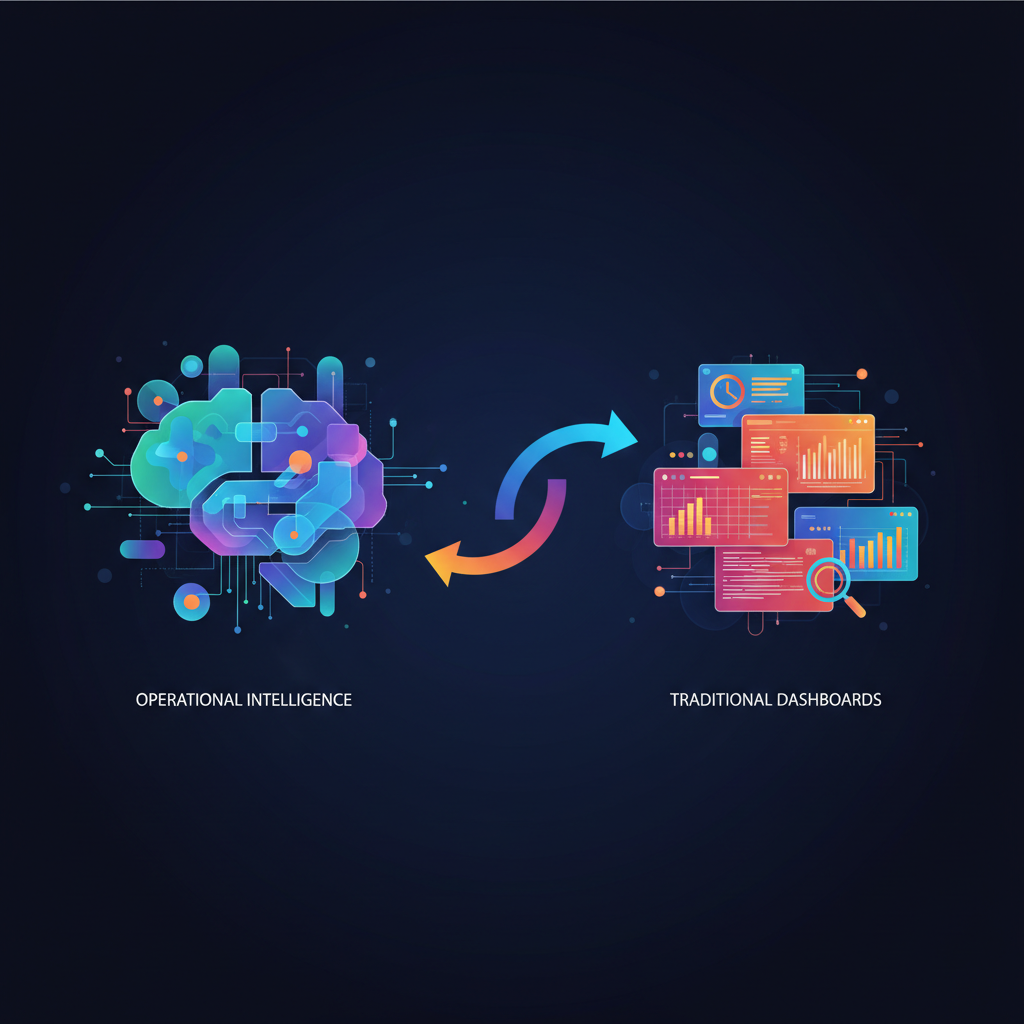
Learn why H.E.R.M.E.S. operational intelligence outperforms legacy dashboards. Real-time decision-making, autonomous metrics, and AI-driven insights for enterpr
The Problem: Your Dashboard Isn't Making Decisions
Your executive team spends Friday morning staring at color-coded spreadsheets. Revenue is down 3%. Customer churn is up. Operational costs in the Mexico City hub exceeded budget by $47K. Someone says, "Let's dig deeper," and suddenly four people are running SQL queries, waiting for the data warehouse to refresh, and debating whether that KPI matters.
Meanwhile, on Monday morning, a competitor has already pivoted their supply chain based on real-time demand signals. They didn't wait for dashboards. They have operational intelligence—AI systems that see patterns humans miss, that adapt in hours instead of weeks.
Traditional business intelligence dashboards are static. They show you what happened. Operational intelligence powered by AI shows you what's happening now and what to do about it. That difference is the gap between companies that survive digital disruption and those that don't.
The Operational Intelligence Revolution
Operational intelligence isn't a dashboard. It's a thinking system.
A traditional BI tool ingests data and displays metrics. You look at it. You interpret it. You decide. The cycle takes days or weeks. Meanwhile, market conditions have shifted, customers have left, inefficiencies have compounded.
Operational intelligence with AI works differently:
- Real-time pattern recognition: AI scans every transaction, every operation, every metric simultaneously. It catches anomalies humans would never notice until the damage is done.
- Autonomous decision-making: The system doesn't wait for a human to interpret a chart. It identifies the problem, runs scenarios, and recommends or executes the optimal action.
- Continuous learning: Unlike a static dashboard, an operational intelligence system learns from results. It gets smarter every day.
- Predictive action: Instead of reacting to last week's problems, the system forecasts next week's bottlenecks and acts preemptively.
For a CEO in Mexico City managing operations across three countries, this is the difference between chaos and control. For a CTO overseeing digital transformation, this is how you move from "business intelligence" to "business advantage."
The Cost of Staying Stuck with Legacy BI
Let's talk numbers, because that's what moves budgets.
Manual interpretation overhead: A typical enterprise with 50+ KPIs across departments spends 200–400 hours monthly just processing business intelligence. Data analysts pull reports. Business analysts interpret them. Leaders discuss them. Decisions come late.
Hidden operational waste: Traditional dashboards show what happened, not why. A 15% drop in service delivery speed might be buried in a footnote. Without root-cause analysis baked into your intelligence system, you're firefighting symptoms, not solving problems.
Missed revenue: A retail chain using static dashboards for inventory doesn't see demand shifts until stock runs out or overstock forces markdowns. A competitor with real-time operational intelligence captures the margin. Study after study shows that companies with data-driven operational excellence capture 5–10% margin advantage over peers.
Lag costs: In Latin America, where supply chains span countries and regulations shift by state, a one-week lag in operational intelligence can cost hundreds of thousands. Currency fluctuations. Regulatory changes. Competitor moves. You need to see and act within hours, not days.
How Operational Intelligence Works: The AI Engine
Operational intelligence systems process three layers:
1. Data Ingestion at Scale
The system connects to every operational source—CRM, ERP, IoT sensors, transaction logs, market feeds, social signals. Unlike traditional BI that waits for scheduled refreshes, operational intelligence ingests and processes data continuously. You get real-time visibility.
2. Pattern Recognition and Anomaly Detection
AI models run constantly, comparing current operations against historical baselines and predictive models. When something deviates—whether a 2% dip in conversion or a 40% spike in support tickets—the system flags it immediately with probable causes.
3. Autonomous Decision Support (and Execution)
This is where operational intelligence becomes truly powerful. The system doesn't just alert you. It models the consequences of different actions, recommends the best path, and can execute routine decisions autonomously. Think: auto-scaling resources before peak traffic, pre-positioning inventory before demand spikes, or adjusting pricing in real time based on demand elasticity.
For a hotel group, this means occupancy optimization without manual intervention. For a clinic network (like those running HeroDoc, Rhodium's AI agent for healthcare operations), this means predicting patient flow, optimizing staff scheduling, and identifying operational bottlenecks before they affect care delivery.
Real-World Impact: From Reactive to Predictive
Let's ground this in a specific scenario: a restaurant chain with 40 locations across Mexico.
Traditional BI approach:
- End-of-day sales data arrives at 11 PM
- Manager sees that Location 12 (Guadalajara) had 18% lower covers than forecast
- By next morning, the regional director investigates—probably staff illness or local event
- By afternoon, they've made adjustments
- Cost of that 18% loss: ~$3,200 in revenue, 2 hours of management time, decision made too late to act
Operational intelligence approach:
- Real-time transaction data flows as orders are placed
- By 6 PM (peak dinner), the system notices covers are tracking 15% below forecast
- AI cross-references external data: local football match (rival game), weather (unexpected rain), competitor activity (new coupon campaign nearby)
- System recommends: accelerate happy-hour pricing, push push notifications to registered members, optimize staff scheduling for lower demand
- Manager sees alert with recommendations and approves in 30 seconds
- Additional actions reduce the revenue gap to 6% and maintain labor efficiency
Annualized impact: 12% performance gap = ~$900K in preserved revenue across 40 locations, plus 480+ hours of management time freed.
This is operational intelligence in practice. It's not about better dashboards. It's about systems that think.
How Rhodium Solves Operational Intelligence: H.E.R.M.E.S.
At Grupo Rhodium, we built H.E.R.M.E.S. (Human Enhanced Metrics Engine Systems) for exactly this use case: enterprises in Mexico and Latin America that need operational intelligence to compete at scale.
H.E.R.M.E.S. is not a BI tool. It's an AI-driven operational command center that:
- Integrates all your data sources (ERPs, CRMs, operational logs, market data, IoT) in real time
- Runs continuous AI analysis to detect anomalies, predict disruptions, and identify opportunities
- Delivers autonomous decision support so your teams act on intelligence, not hunches
- Scales across geographies — critical for enterprises managing operations in multiple countries with different regulations and conditions
- Learns from outcomes to improve recommendations daily
H.E.R.M.E.S. is built on Rhodium's Get Shit Done™ methodology: design, assemble, and operate. We don't install software and leave you to figure it out. We implement, train, and run the system with you—getting you to operational impact within 30 days.
For a CTO, H.E.R.M.E.S. means:
- No more building custom BI dashboards that go stale
- No more waiting for data warehouses to refresh
- Real-time operational visibility baked into your infrastructure
For a CEO, it means:
- Decisions informed by AI, not instinct
- Operational costs under predictive control
- Revenue opportunities captured before competitors see them
For a director of operations, it means:
- Alerts that matter, with recommended actions
- Automation of routine decisions
- Your team focused on strategy, not data interpretation
Operational Intelligence Is the New Competitive Edge
Companies that invest in operational intelligence now will dominate their verticals in 3–5 years. Those that stick with legacy BI will find themselves reacting to disruption instead of driving it.
The gap isn't technical. It's cultural and strategic. Do you want systems that show you what happened, or systems that help you shape what happens next?
In Mexico and Latin America, where operational complexity is high (multiple countries, regulations, time zones, supply chains), operational intelligence isn't a luxury—it's the infrastructure of competitive advantage.
Ready to Operate with Operational Intelligence?
At Grupo Rhodium, we design, assemble, and operate AI systems that transform enterprise operations. H.E.R.M.E.S. is our operational intelligence platform for corporations and government—built to scale across geographies, industries, and complexity.
We don't sell dashboards. We build thinking systems. Our Get Shit Done™ methodology gets you from strategy to impact in 30 days.
Let's talk on WhatsApp about your operational challenges. Tell us what's slowing you down, and we'll show you how H.E.R.M.E.S. changes the game.
Explore more articles on operational AI and enterprise automation on Rhodium's blog. Learn how companies like yours are transforming operations with AI-driven decision systems.
Learn more about Grupo Rhodium at rhodium.ooo.